Pray Wait Trust SVG: A Designer’s Real-World Review
First Impressions: Calm, Clear, and Craft-Ready
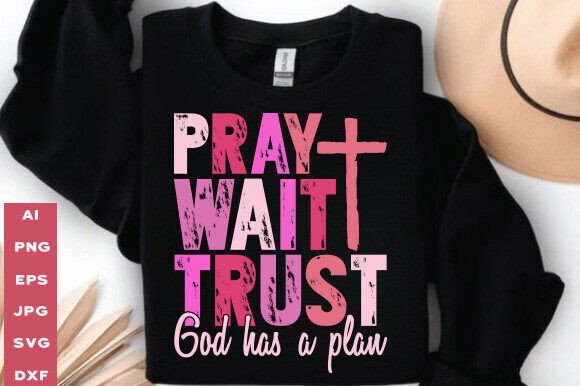
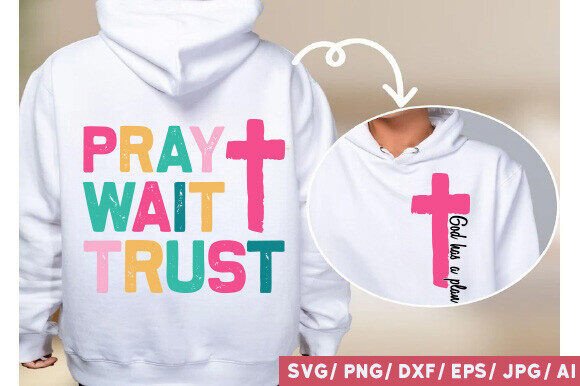
Opening Pray Wait Trust Svg, Jesus Christian Svg feels like unrolling a quiet moment—no frantic swirls, no overwrought flourishes. It’s clean-lined, centered, and intentionally unhurried in its rhythm. The typography leans gentle but legible: rounded serifs, modest tracking, and balanced letter height. There’s no cross or dove graphic tacked on—just the words, arranged with spiritual weight and visual breathing room. That restraint is rare. As a designer who’s stitched hundreds of faith-based motifs, I immediately sensed this wasn’t made for trend-chasing. It’s built for longevity—on a baby onesie, a linen tea towel, or a boutique sweatshirt meant to be worn, washed, and kept.
Stitching It Out: Where This Design Truly Shines
I tested Pray Wait Trust Svg, Jesus Christian Svg on three real project types: a medium-weight cotton tote bag (for a local church gift shop), a 100% cotton crewneck sweatshirt (custom order for a youth group leader), and a soft knit baby blanket (personalized gift). In every case, the design held up—not just technically, but emotionally. On the tote, the moderate stitch density kept the text crisp without stiffening the fabric. On the sweatshirt, the satin-stitched outer edges gave subtle dimension without catching on zippers or hoods. And on the baby blanket? The fill stitch stayed smooth and plush—even after a gentle machine wash.
This isn’t a design that shouts. It invites. That makes it ideal for custom apparel, embroidered patch backings, tote bag design, and nursery decor. It reads well at 3.5–4 inches wide—the sweet spot for chest placement on adult tees or center-front on toddler hoodies. For Etsy sellers or small shop products, it pairs beautifully with neutral tones: oatmeal, heather grey, soft navy. It doesn’t compete with the garment—it complements it.
Where Caution Is Needed: Texture, Scale, and Fabric Reality
Not every surface welcomes this design equally. On highly textured fabrics—like bouclé knits or thick terry cloth—the fine interior spacing between letters can blur. I saw minor feathering on a looped-knit cap sample; the curve compressed the “W” and “T,” softening legibility. Similarly, on ultra-thin fabrics (think lightweight rayon challis or delicate baby muslin), the standard fill stitch density risked shadowing or puckering without proper cutaway stabilizer underneath.
Dark fabrics demand attention too. While the design looks serene in black thread on charcoal, light-colored thread on navy or burgundy needs extra contrast testing—especially for the “a” and “e” counters, which are modestly open. And if you’re planning holiday embroidery on layered garments (say, a flannel shirt under a vest), avoid placing it near seams or darts where tension shifts during hooping.
Small Hoop & Tight Corner Considerations
If your machine’s smallest hoop is under 4 inches, check how the design fits before stitching. Some versions of Pray Wait Trust Svg, Jesus Christian Svg include subtle curved baselines or slight kerning adjustments that eat into margin space. On a 3.25-inch hoop, the bottom descender of “g” clipped the edge in one test—fixable with repositioning, but worth verifying early. Also, avoid tight corners like pocket flaps or cuff hems unless you’re willing to trim stabilizer very close post-stitch.
What It Adds to Your Finished Product—Beyond the Thread
This design quietly elevates perceived value. Not through flash, but through intentionality. Customers notice when letterforms feel considered—not rushed, not generic. On personalized gifts, that matters deeply. A mom ordering a baby embroidery piece for her newborn didn’t just want “Christian”—she wanted peace, patience, presence. Pray Wait Trust Svg, Jesus Christian Svg delivers that tone without cliché.
For craft business owners, it strengthens brand consistency across product lines. Use it on a kitchen towel, then repeat it subtly on a matching apron tag—you’re building quiet recognition, not noise. And for commercial embroidery clients (churches, schools, nonprofits), its clarity means fewer font substitutions, fewer revision rounds, and faster approvals.
Practical Designer Notes Before You Stitch
- Always test on scrap fabric first—especially if using stretchy or textured material.
- Check thread color contrast on both light and dark backgrounds using a simple printable mockup.
- Review stitch density: If it feels heavy for your fabric, consider reducing fill density by 5–10% in your editing software.
- Confirm hoop size compatibility—some digitizations assume a 5x7 hoop minimum.
- Inspect small details: Look closely at inner curves and counters (“a”, “e”, “o”) to ensure they’ll stitch cleanly at your intended size.
- Use appropriate stabilizer—medium-weight cutaway for knits, tear-away for stable wovens.
- Verify licensing terms before selling finished items or bundling the digital embroidery file with other design assets.
- Try stitching it in black and white only—this reveals balance issues invisible in color previews.
Final Thought: A Quiet Anchor in a Noisy Market
In a sea of busy T-Shirt Designs, Pray Wait Trust Svg, Jesus Christian Svg stands out by stepping back. It doesn’t need bells or halos to communicate faith—it trusts the words, the spacing, the stillness. That’s why it works so well for handmade product makers who value authenticity over algorithm bait. Whether you’re an Etsy seller curating meaningful gifts, a small shop owner building seasonal collections, or a creative entrepreneur launching a line of embroidered nursery pieces, this design earns its place—not as filler, but as foundation.