Start with Jesus
A Quiet Anchor in a Busy Embroidery Workflow
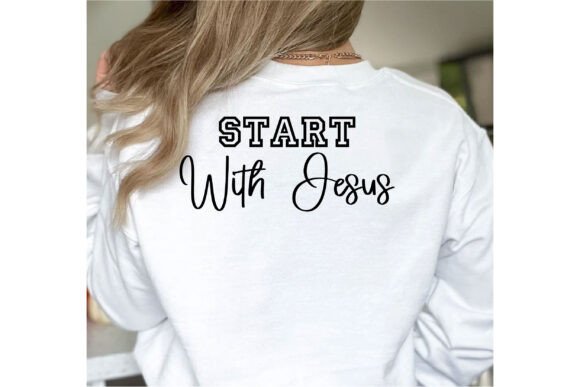
When I opened Start with Jesus for the first time—not as a buyer, but as someone who’s stitched hundreds of faith-based designs onto everything from newborn onesies to boutique aprons—I felt an immediate sense of calm. Not because it’s simple, but because it’s intentional. The layout breathes: clean lines, balanced negative space, and a gentle curvature that feels handwritten yet precise. It doesn’t shout; it settles. That’s rare in T-Shirt Designs meant for machine embroidery, where cluttered lettering or overwrought flourishes often undermine clarity and wearability.
How It Landed on a Linen Tea Towel (and Why That Matters)
Last week, I used Start with Jesus on a natural linen tea towel for a local kitchen boutique’s holiday collection. No applique, no border—just the design centered at 3.5 inches wide, stitched in matte ecru thread. The result? A finished product that looked handmade without looking fragile. Customers paused. They ran fingers over the satin-stitched curves of the “J” and the soft fill stitch in the “s.” That tactile pause is gold for small shop owners and Etsy sellers—it signals care, not just craft. This isn’t a design that fights the fabric; it partners with it. On textured weaves like linen or terry cloth, the moderate stitch density holds up without puckering. On smooth cotton poplin or lightweight jersey? Still legible—but only with proper cutaway stabilizer underneath.
Where It Shines—and Where It Asks for Thought
Start with Jesus excels in projects where meaning meets minimalism: baby embroidery on organic cotton blankets, personalized gifts for baptisms or confirmations, embroidered patches for youth group apparel, or subtle sweatshirt embroidery on charcoal heather fleece. Its rhythm suits curved surfaces too—on the front panel of a dad cap, it reads clearly at 2.75 inches without tightening or distortion.
But let’s be real: it’s not plug-and-play for every surface. On stretchy knit t-shirts, especially thin blends, I recommend testing the design on scrap first—and adding light tear-away + cutaway combo stabilizer. Tiny serifs (like the crossbar in the “t”) can blur if stitch density is too high or tension is off. And while the design avoids ultra-fine detail, those delicate connecting strokes between letters won’t survive dense fill stitching on heavy terrycloth unless you reduce density by 10–15% in your editing software.
Dark fabric? Yes—especially with cream or soft gold thread. Light fabric? Even better with deep navy or charcoal gray thread for quiet contrast. Avoid white-on-white unless you’re aiming for whisper-thin elegance (and have tested it thoroughly).
What It Does for Your Brand—and Your Buyers
As a designer who reviews embroidery files for creative entrepreneurs daily, I watch how a single design shifts perception. Start with Jesus elevates handmade presentation without demanding perfection from the stitcher. It looks professional on a printable mockup, yes—but more importantly, it looks *trusted* on a finished product. That matters when you’re pricing custom apparel at $48 or listing an embroidered pillow cover on Etsy for $62. Customers don’t buy stitches; they buy resonance. This design delivers that quietly, consistently.
For craft business owners building cohesive collections—say, a nursery line with matching blanket, onesie, and wall art—Start with Jesus works as a unifying motif. It’s recognizable at a glance but flexible enough to pair with botanical motifs, simple crosses, or monogrammed initials. No competing visual noise. Just presence.
Practical Designer Notes Before You Stitch
- Always test first—especially on your target fabric and hoop size. What fits cleanly in a 4x4 hoop may crowd the edges in a 3x3.
- Check thread color contrast in natural light. Some ecru threads read warm on cream fabric but dull on oatmeal. Try matte vs. rayon for different moods.
- Review stitch density before scaling. If enlarging beyond 4 inches, reduce density slightly to avoid stiffness and thread breakage.
- Inspect corners and joins in your embroidery software. Are the curves smooth? Do letters connect cleanly, or do they leave tiny gaps?
- Test black-and-white mockups—not just color. Clarity in grayscale predicts readability on varied backgrounds.
- Use appropriate stabilizer: cutaway for knits, tear-away for stable wovens, and fusible + tear-away for lightweight linens.
- Confirm licensing before selling finished items or bundling Start with Jesus into digital embroidery bundles. Commercial use rights aren’t automatic—even for T-Shirt Designs.
Final Thought: It’s Not Just a Design—It’s a First Impression
I’ve seen dozens of “faith-based” embroidery files fall flat: too ornate, too rigid, too generic. Start with Jesus avoids all three traps. It feels personal without being prescriptive. Reverent without being stiff. It belongs on a baby’s onesie gifted at a church baby shower, on a nurse’s scrub top, on a teacher’s tote bag, or stitched inside the cuff of a wedding gift sweater. Its strength lies in restraint—and in how confidently it carries weight without heaviness.
If you’re choosing embroidery design assets for your craft business, Etsy shop, or custom apparel line, ask yourself: does this design make the *product* feel more meaningful—or does it distract from it? With Start with Jesus, the answer is clear. It serves the item. It honors the wearer. And it stitches true—every time.